
The Thompson Submachine Gun: Evolution from Battlefield to Law Enforcement Artifact
The Thompson submachine gun is one of the recognizable firearms in history. It is known for its build, vertical foregrip and different types of magazines. Its shape appears often in movies and popular culture.. Its origins are not about fame. They are about war. The Thompson was designed to meet a need during World War I. It was meant to give soldiers an automatic weapon that could be used in trench fighting.. The war ended before the weapon could be used in combat. That left the designers with an invention that had no battlefield purpose.
Origins of the Thompson: A Weapon for Trench Warfare
John T. Thompson was an officer and arms designer. He wanted a weapon that could deliver a lot of firepower in combat. He worked with the Auto-Ordnance Corporation to create this weapon. They used a delayed-blowback mechanism that had been developed by John Bell Blish. The first version, called the Model of 1921 used.45 ACP cartridges.. The production process was complicated. That made the Thompson expensive to build.
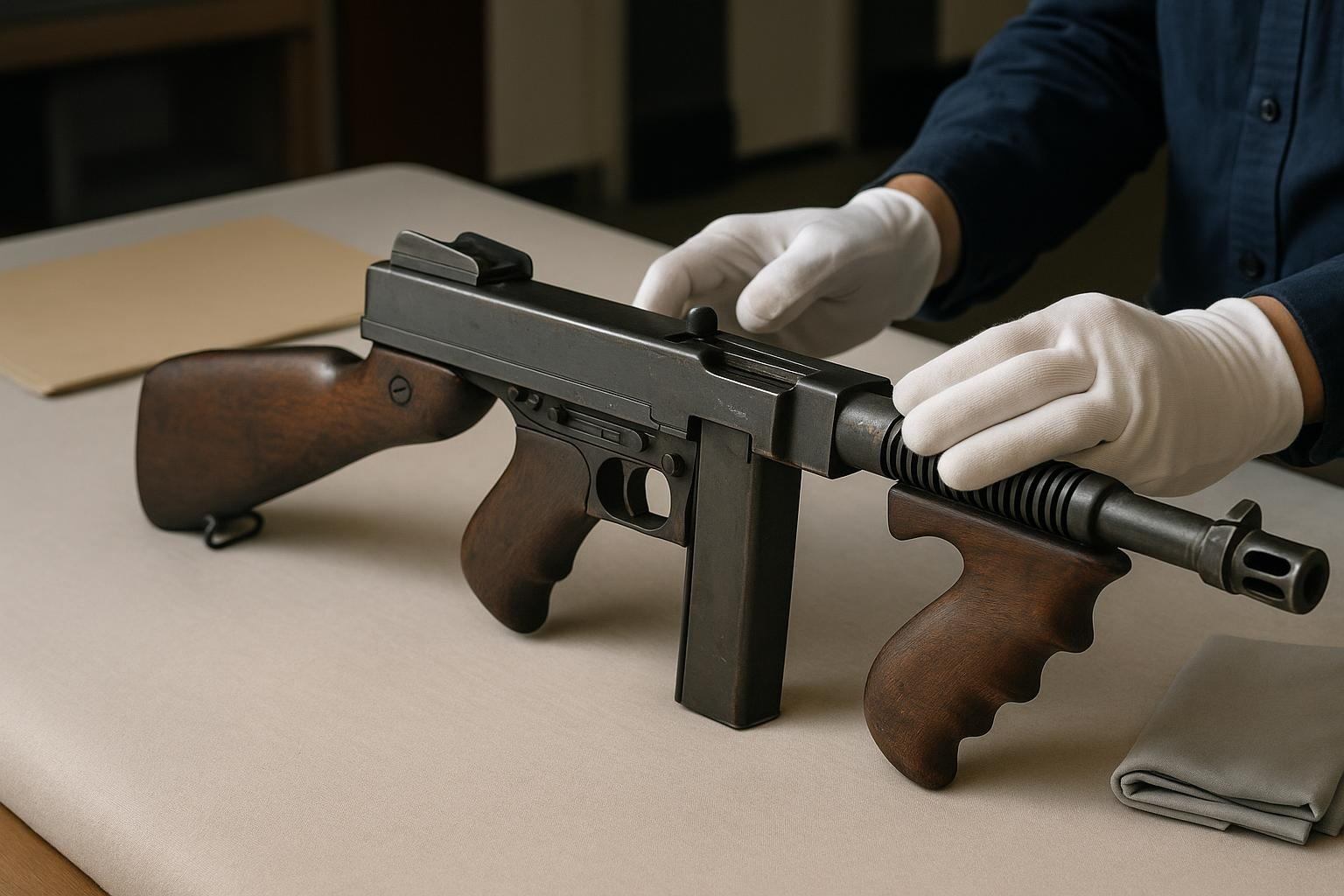
The design included important features. There was a barrel to help with cooling during long bursts of fire. A Cutts compensator was added to reduce recoil and improve handling. The receiver could take both box magazines and drum magazines. These choices showed the goal: make a weapon that was easy to carry and tough enough to last.. After the war there were no big military orders. The Thompson did not become a battlefield weapon. Its path into life was different.
From Battlefields to Police Forces
Many people think of the Thompson as a gangster gun. That idea is powerful.. It hides a deeper story. The Thompson did find a role in law enforcement. That role became important during a time of rising crime and daring bank robberies. Police departments faced criminals who used heavy weapons. This pushed departments to consider using weapons. The decision was not simple. It came with responsibilities.
There were questions to answer. How would officers be trained? How would the weapons be stored? Who had the right to use them? These were not concerns. As the Thompson moved into police hands it did not spread equally. Some departments used them. Others did not. The presence of the Thompson in a police department did not mean every officer carried one. It meant one department had chosen to use it.
To understand the history of a Thompson in a police department you need more than a look. You need proof. You must look at property marks, inventory records and old photos. A photo from an era might show the Thompson in use.. Without documentation the link is weak. The appearance of a Thompson is not enough. You need evidence to connect it to a department, a time and a role.
Design Evolution During Wartime
World War II changed everything for the Thompson. The weapon found a purpose. The military needed weapons again. The M1928 model was developed. Then came the M1 and M1A1. These models were simpler than the original. The complex parts were removed. The design became easier to build. The M1A1 for example used a fixed firing pin. This made the bolt easier to make. It also made the weapon more reliable. Still it worked well in combat.
When you examine a Thompson, the small details matter. The position of the charging handle the shape of the receiver and the type of magazines it accepts can tell you a lot. These differences help identify the model and the year. They are not just cosmetic. They show how the weapon changed over time. They show how military needs shifted. They reveal how production priorities changed. Each change adds to the story.
The Iconic Image and Its Misleading Narrative
The Thompson is often seen as a "gangster gun" in movies and TV. That image is strong.. It is not the full story. It misses the history. The Thompson was used by police. It was used by soldiers. It was used in ways that required planning, training and rules.. The public image focuses on the flashy, the violent, the criminal. That leaves out the discipline, the procedure, the responsibility.
Museums and historians need to correct this. The difference between history and popular culture must be clear. When a Thompson is on display the story should be honest. If the records are missing say so. Do not make claims without evidence. Use phrases like "consistent with" or "possibly" of "definitely." That keeps the story accurate. It is better to say "we do not know" than to invent a story.
For anyone studying a Thompson with police markings the focus should be on proof. Not on how it might look. Not on what it could have been.. On what it actually was. The evidence must stand on its own.
Understanding Wear and Its Implications
The wear on a Thompson can tell you a story.. It cannot tell the whole story. For example wear around the sling mounts might mean the gun was carried often. Wear near the grip might come from tools, not bullets. Repair work can change the picture. Parts can be replaced. Finish can be restored. These changes can hide the history.
Photos can help. They show how the weapon was used over time. They show how equipment changed.. Matching a gun to a photo is hard. It needs proof. It needs a chain of evidence. Without it the connection is weak.
To keep the story straight here are some steps:
– Record all markings before cleaning or taking the gun apart.
– Keep observations from guesses about the past.
– Compare parts to known references from the right time period.
– Save all paperwork that shows where the gun came from.
Before anyone handles the gun, a qualified expert should check it. Firearms laws change. Possession rules change. You must follow the laws. That is part of preserving the past.
The Thompsons Enduring Legacy
The Thompson is more than a weapon. It is a turning point. It helped shape how automatic weapons were built and used. It showed how military tools could become part of life. It showed how technology can shift from war to peace. It showed how a tool can become a symbol.
In museums the Thompson is not metal. It is a collection of stories. It is the records, the photos, the notes, the decisions. These things matter. They tell the history. The true value of a Thompson is not in its look. It is in the details. It is in the journey.
When you look at a Thompson do not just see the gun. See the time it lived. See the people who used it. See the choices that were made. See the system that supported it. The Thompson is not an icon. It is a lesson. A lesson in design. A lesson in history. A lesson, in how the world changes.