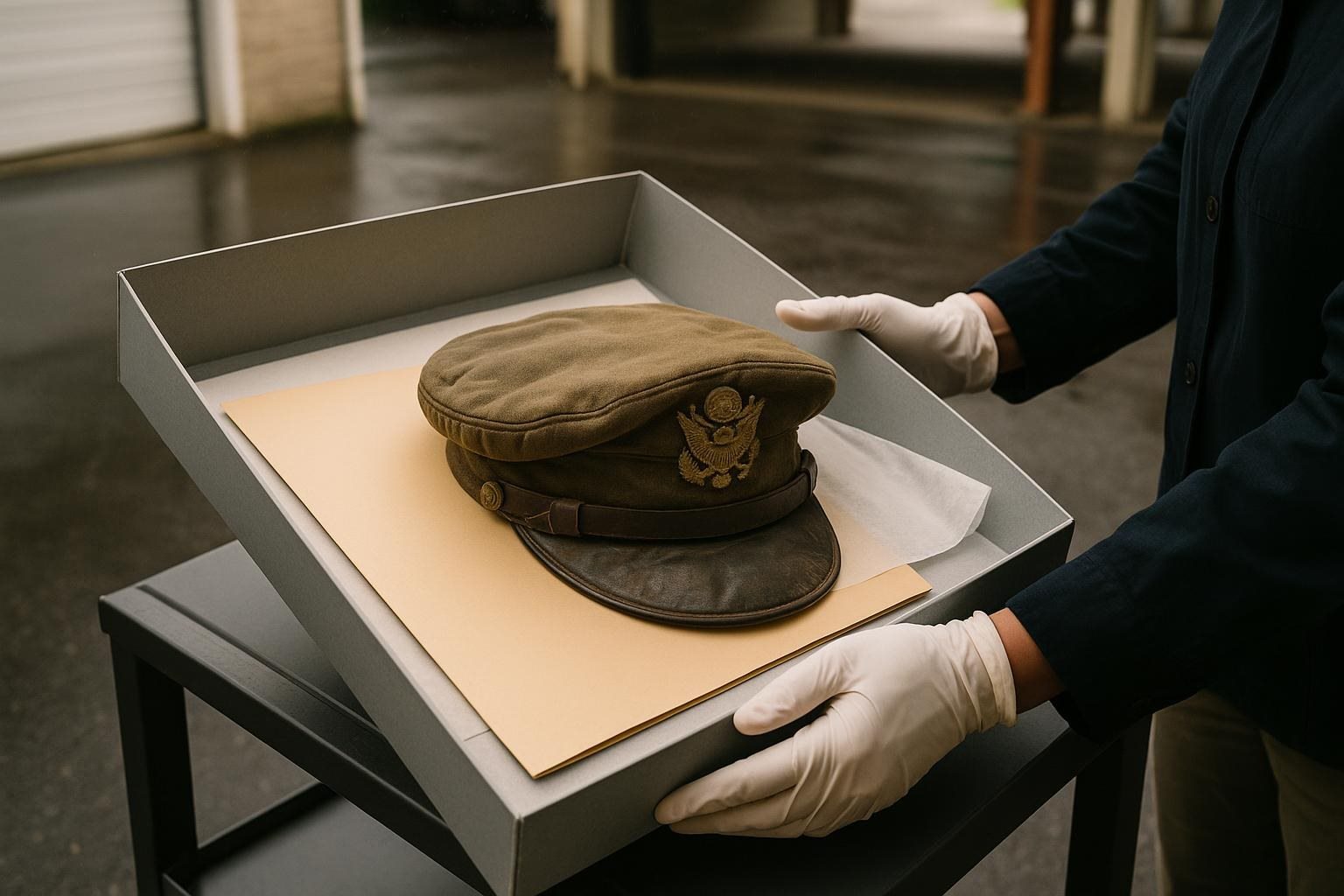

A handwritten name inside a battered service cap can change the meaning of an ordinary object. Wear, repairs and an unclear history may reveal little alone. Add a family note, photograph or roster entry, and the cap becomes evidence of a person moving through an institution, conflict and community.
That is why local collections matter. They preserve small, incomplete traces that large national narratives often omit. Their value lies not only in rarity, but in context, careful interpretation and the chance to connect public events with the people who experienced them.
The first turning point: equipment becomes personal evidence
Military objects were once described chiefly by function: a rifle as a weapon, a mess tin as field equipment and a uniform as an example of dress. Those descriptions are useful, but they flatten the human story. Objects also carry signs of handling, adaptation and memory.
A repaired strap may suggest scarcity or long use. A marked canteen may indicate ownership, though the mark must be verified rather than treated as proof. A medal can show recognition, but not what the recipient endured or how relatives understood the award. Objects offer clues; documents and testimony test them.
Material culture should begin questions, not replace answers. A responsible label distinguishes between what is visible, what is documented and what remains uncertain.
The second turning point: museums widen the record
Curators, archivists and community researchers increasingly look beyond official reports. Military records emphasize commands, operations and outcomes. Personal letters, workbooks, photographs, ration books and family papers reveal the quieter structures around those events: separation, waiting, labor, fear, boredom and return.
This wider record also changes who appears in the story. Civilians who made uniforms, nurses, interpreters, mechanics, clerks and relatives maintaining households all shaped wartime experience. Their contributions may survive in a sewing kit, correspondence file, factory badge or telegram rather than an operational report.
Local collections are well placed to gather these fragments because they often grow through donations and community memory. A small archive may hold an object whose significance is invisible without local knowledge. That knowledge should be recorded, compared with available evidence and preserved with the object, rather than left only in a volunteer's or donor's memory.
The third turning point: law enforcement history enters the frame
Military and law enforcement histories are not interchangeable, but local collections often show where their material worlds and public responsibilities overlap. Badges, duty notebooks, training manuals, holsters, photographs and dispatch records can document how communities responded to unrest, emergencies, disasters or social change.
An artifact becomes more informative when placed beside policy and circumstance. A department photograph may show uniforms and equipment, while a ledger reveals routine calls, staffing pressures or the language used to describe residents. Neither source is complete, and both require careful reading, especially when records were created by institutions with authority over the people they documented.
Firearms history requires the same discipline. A weapon, cartridge, storage case or inspection mark can illuminate technology, procurement and institutional practice, but cannot by itself explain an incident or a person's character. Identification, ownership and use require corroboration. Legal requirements for possession, display, transport and transfer can change, so researchers and collectors should consult current official guidance before handling or moving regulated items.
The fourth turning point: community archives challenge the single story
Community archives changed the balance of authority. Local historians, families, veterans' groups and neighborhood organizations began preserving photographs, oral histories and ephemera rather than waiting for every important record to enter a major institution.
That does not make every memory accurate. Recollections can shift, captions may be added later and family traditions can combine several events. Yet excluding such sources creates its own distortion. A photograph without a name may become identifiable through a reunion program; a service number may connect a uniform to a personnel file; a local newspaper may confirm that an object appeared at a particular memorial event.
Good public history makes the chain of evidence visible. It records who supplied an item, what was known at donation, which sources support the interpretation and which questions remain open. Provenance is not decorative paperwork; it protects an object's meaning from being replaced by a convenient story.
Preservation is a series of informed choices
Preserving a local collection does not mean freezing every object in perfect condition. It means deciding what can safely be stabilized, described and made accessible while acknowledging limits. Paper may need low-light storage; textiles can be damaged by poor handling; metal can corrode when moisture is uncontrolled. Treatment should be documented, and specialized work referred to a qualified conservator.
Digital preservation brings different decisions. Scanned letters and photographs need consistent filenames, descriptive metadata and more than one secure copy. Oral histories require consent, clear attribution and honest notes about editing. Privacy may matter as much as access when records include addresses, medical information, allegations or details about living people.
The useful question is not simply, "Can this be displayed?" but "What does display help the public understand, and what might it expose or misrepresent?" That keeps preservation connected to people rather than turning artifacts into stage props.
Reading a local collection with care
Visitors and researchers can ask:
– What is directly visible on the object, and what comes from a later label or family account?
– Is there a documented chain of ownership, or is the provenance partial?
– Which records support the proposed date, location, identity or use?
– Whose perspective is present, and whose may be missing?
– Are privacy, cultural sensitivity or current firearms regulations relevant to access?
These questions make appreciation more honest and give volunteers and small museums a practical standard for improving descriptions as evidence develops.
The strongest local collections do not compete with national institutions by trying to tell every story. They keep names attached to objects, preserve uncertainty alongside fact and show how broad events reached particular homes, streets and workplaces. A worn cap, duty ledger or carefully labeled photograph can connect institutional records to lived experience-provided the collection preserves not only the object, but also the evidence and responsibility surrounding it.