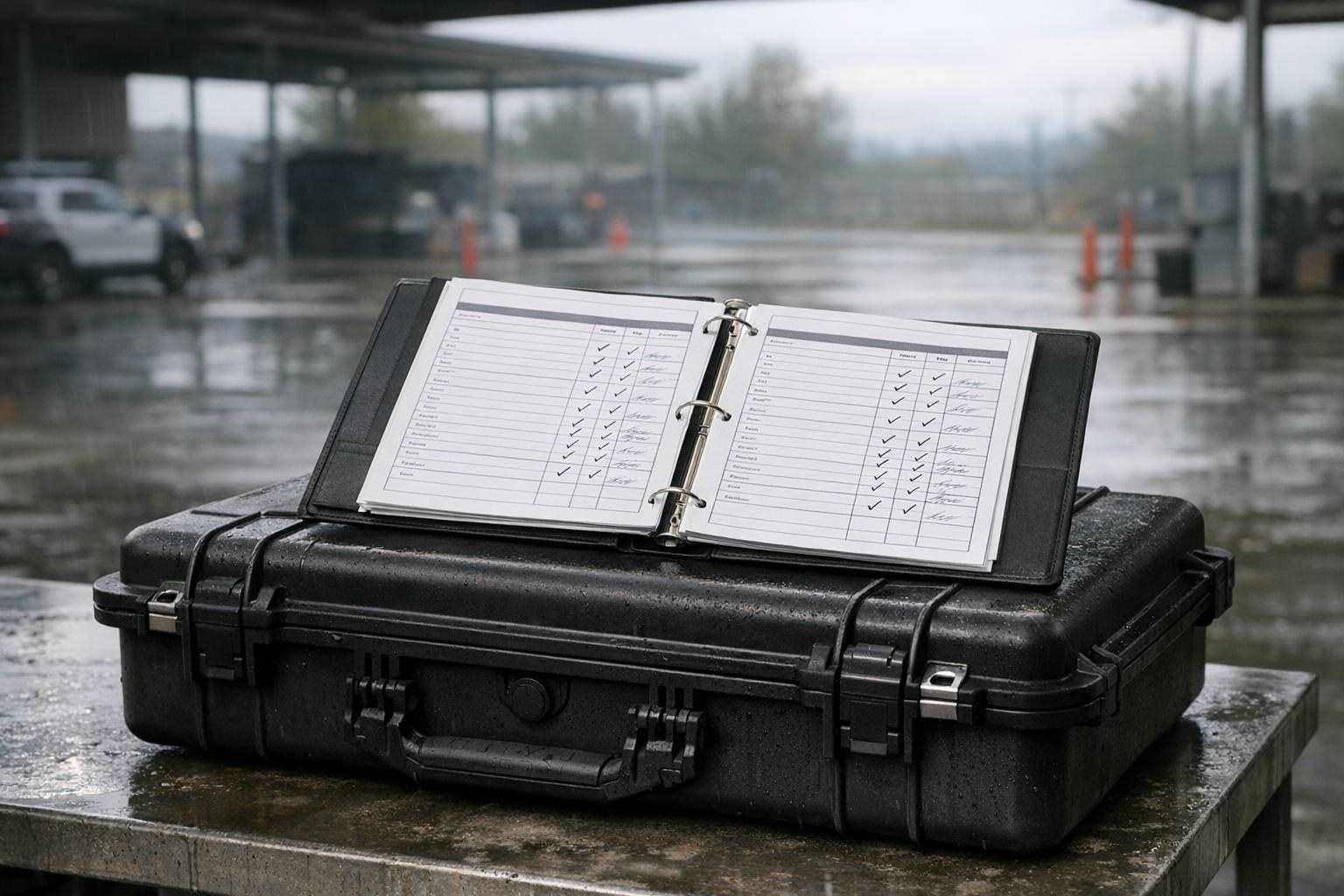

Historical service records can provide a wealth of information about a piece of equipment and the service it received within a law enforcement workplace. Typically these documents will contain details of inspections conducted and the findings, actions taken and individual(s) responsible for those actions.
Changes to the service record have included changes in format. At first glance these have been largely technological but have actually included major changes in how items are monitored and recorded for accountability by different members of the workplace.
When the paper ledger became the first control
When the paper ledger became the first control, for example, the date an item was serviced would have been written near to the item itself on the form, thus creating a historical document that could be read by others. That such an item had been serviced at all was of course crucial.
Useful paper entries contain sufficient information to allow someone else to understand the circumstances, to identify the object in question, the date and time the inspection took place, who made the observations, what action was taken as a result, and who accepted responsibility for that action.
On the other hand, these systems did have limitations. For example, handwriting can be very difficult to read and in the long term, paper based systems can get into a real mess – pages go missing for example and although you can have copies of information made, these can soon get into a mess as well and drift off in different directions.
Standard forms turned memory into a process
Standard forms were next, to formalize the task of recording as a process that is done by more than one person. Such forms ensure that similar items are described by similar data.
Consistency creates traceability. Standard forms mean that everyone using a similar piece of equipment completes similar information. For example, identifying marks are recorded, the date of inspection is recorded, a description of the reported defect is completed, a description of any service carried out is completed, and the final disposition of the item is completed.
Tracking who is responsible for service actions is important. The person that identifies that a service is required may not be the same person that can action the service. However this must be clearly recorded within the procedure and the individual entries on the forms.
Service reports added the story behind a date
An inspection date provides the when of an event but the date itself does not provide any information regarding findings from an inspection. Service reports outline the reasons for an item having been inspected and the work undertaken on an item and the status of an item subsequent to the service having been conducted.
It is important to keep the Service Report specific to the circumstances as they occurred. If an item of equipment was cleaned, adjusted, repaired or even referred for further assessment then record these facts on the report. The fact that no fault was found is also a result and must be recorded on the report. A blank space would be unknown to the reader as to whether equipment had been inspected or not and if so what had happened to it.
Tracking an item that has been moved around between reported concerns and their resolution (and subsequent return, transfer or disposal) is also essential. Until a satisfactory service has been completed on an item, it remains part of the "work in progress". Subsequently, it would need to be recorded as to where it has been transferred to.
Digital systems changed speed, not responsibility
The move to computerized record systems helped in terms of searching for previous records, particularly around dates. The ability to filter lists and to attach supporting information to a record was also of great value. However, completed information that is displayed within a highly developed user interface can often look complete even when it is not.
Even digital entries should consist of clear events (with a responsible person!) and contain sufficient information about their current status. By controlling access to data, documenting changes to entries and consistently naming fields in the system, it is possible to ensure that all staff members use digital records in a consistent manner and thus gain full value from the functionality provided by the system.
Where technology is used to create and manage records of equipment maintenance and repair, these should still be able to be read by others to ensure that memory of what was done is not lost. The ability to track any changes to records, and the reasons for them, is also important to prevent mistakes being accidently built on. Systems and local procedures and requirements should be updated in line with any changes in official requirements and policies.
Accountability moved from possession to ownership of the record
Once responsibility for recording equipment in a workplace has been distributed amongst personnel it is equally as important to ensure that all are aware of their respective roles in recording and subsequently referencing completed maintenance activities.
Responsibility needs to be clearly assigned and to be traceable in the form. The person who writes in the form needs to be clearly identified. The person who completes the form for a routine inspection needs to be clearly identified from the person who completes the form for repairs etc. The supervisor who reviews outstanding service actions for equipment needs to be clearly identified.
One of the biggest pitfalls with updating equipment records is assuming someone else will do it and it will magically appear in the system. Make sure there is a clear handoff between individuals and tasks are transferred with the same rigor as completing an inspection. Accountable completion of a task and updating of the record needs to be visible to others and occur as part of completing a task.
A traceable record survives the original workplace
The value of the earlier record-keeping by the policing workplaces and organizations, of their equipment, services and materials, lies not only in the material proof of how things were serviced, and looked after by the department, before they were put into a museum, archive or collecting institutional context, but also in outlining the development of the organization's standards and ways of work.
Preservation of paper records in good condition includes the context in which the document was completed. Service reports should be kept with identifying information (the item which was inspected), dates of inspection, and subsequent service reports to create a history of working with the item. Corrections to completed forms should be recorded together with the reason for the correction and the relationship to the completed form(s).
Consider the following set of simple questions for reviewing current practice for recording equipment maintenance action and completing of records of these actions to ensure they are adequate for future use for historical research. 1) Would another staff member be able to recognize the item. 2) Would they be able to identify when an inspection of the item was carried out. 3) Would they be able to identify what action was taken as a result of that inspection. 4) Would they be able to identify who was responsible for that action.
There is much to be learned from the historical development of all these different types of records to use for different purposes about the changing nature of the institutional memory of a police workplace over time. And a basic duty of all of those different types of records of equipment of all different types is to make a satisfactory account of the history of that piece of equipment to be able to convey its story to the next person in due course.